"La Noire de...", Ousmane Sembène (1961)
Expanding the archive's focus, we now examine the nuances of suicide and how taking one's own life shifts the power dynamics of the "right to rest." In Ousmane Sembène’s "La Noire de...", the corpse is not silenced from without; it is a body that has reclaimed itself from a suffocating colonial reality, forcing the living to negotiate with a subject they cannot penetrate.

Writing her story
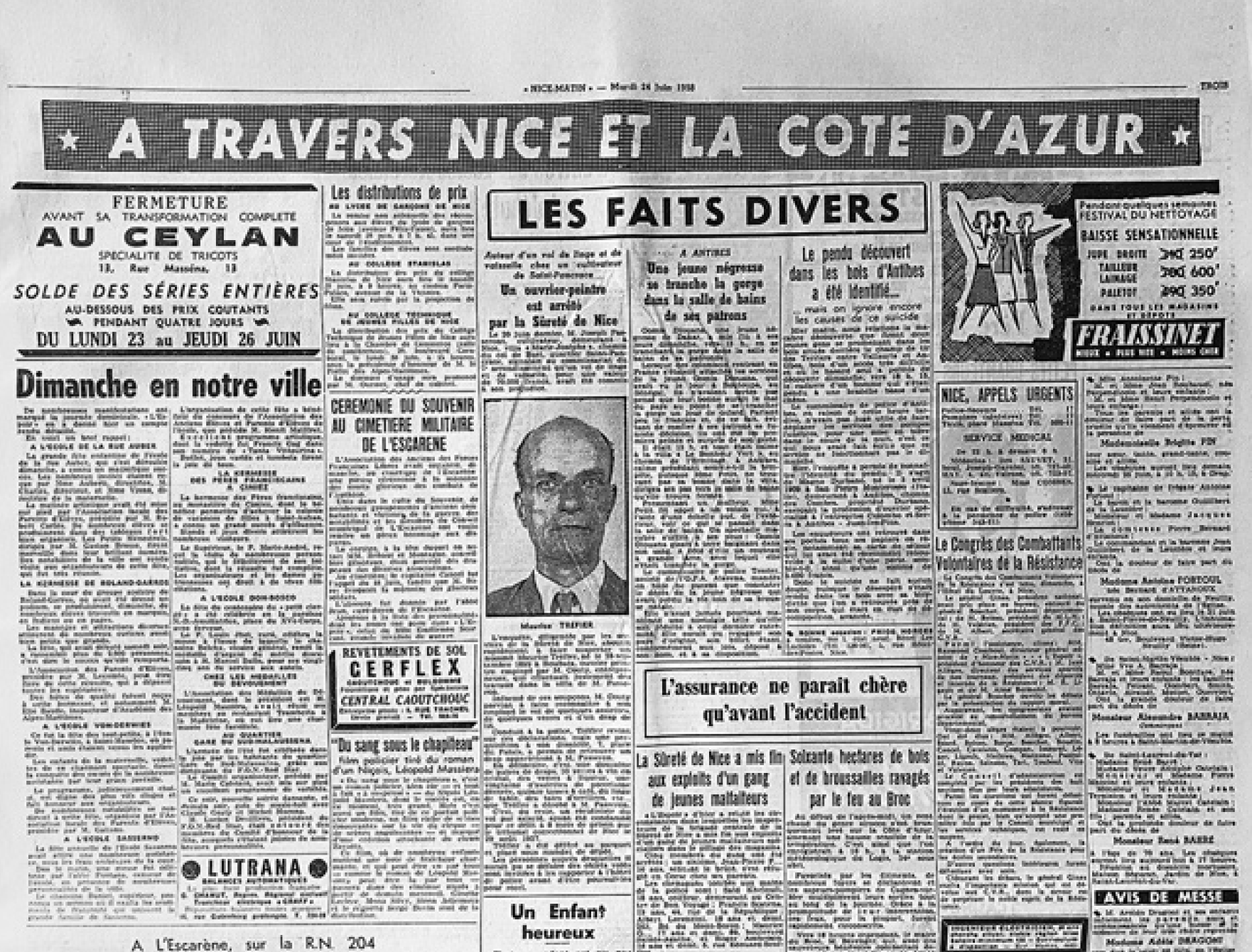
Initially inspired by a real-life newspaper article and later adapted into a landmark film, Sembène’s short story tells the tragedy of Diouana, a Senegalese woman hired by a French family to look after their children. After three years of domestic isolation, excessive labor, and the linguistic walls that prevented her from negotiating her own existence, Diouana takes her own life. The story utilizes a non-linear structure, beginning with her death and looking backward to uncover the routinized violence that pushed her to the brink.
Pathologizing her suicide
When Diouana’s body is found, the villa transforms into a crime scene where her remains are immediately subsumed by a wave of police officers and coroners. Here, the corpse is treated as a fait divers—a short and sensational piece of information to be perused rather than a person to be understood. The text highlights a stark lack of respect for the dead as the living attempt to pathologize her act, dismissing it as "nostalgia" or a "melancholic day." By focusing on a sentimental "why," the authorities sidestep the systemic trauma of her domestic enslavement. Her suicide serves as a "radical self-silencing" (Calhoun), yet the living insist on making her body speak for their own comfort.


The transmedia cloud
This story has been reinterpreted across literature and film, remaining a focal point of academic research and teaching to this day. Yet, the constant repetition of this fictional narrative—inspired by the real-life death of Diouana Gomis in 1958—risks committing "further violence" by rendering a private, desperate departure useful for a public audience (Calhoun). Much like the coroners and police officers who attempt to extract an official explanation from her act, Sembène himself participates in the continuation of a story for a woman who used her body to agentively end it. Each new iteration brings the migrant corpse back onto the stage, symbolically barring the real woman from her "right to rest." Ultimately, the literary medium writes her in and out of the narrative simultaneously, framing a body that is only granted a voice through the distorted memories of those who exploited her.
Voicing the dead and questions of burial
At a crime scene such as the one in "La Noire de...", the migrant corpse temporarily becomes property of the law rather than the family. Unlike the bodies of migrants in other exhibits who strive for repatriation, Diouana’s body is momentarily suspended, floating in an in-between space where the choice for burial remains unmade as the investigation takes precedence. Sembène's short story and subsequent film grant the migrant a visibility denied to her in the morgue. However, this creates a paradox for the "right to rest": while fiction allows us to honor her agency, it also ensures that the migrant corpse remains in a state of perpetual public performance, never truly allowed to exit the stage and enter the quietude of a private grave.